Written by:
Occam Systems

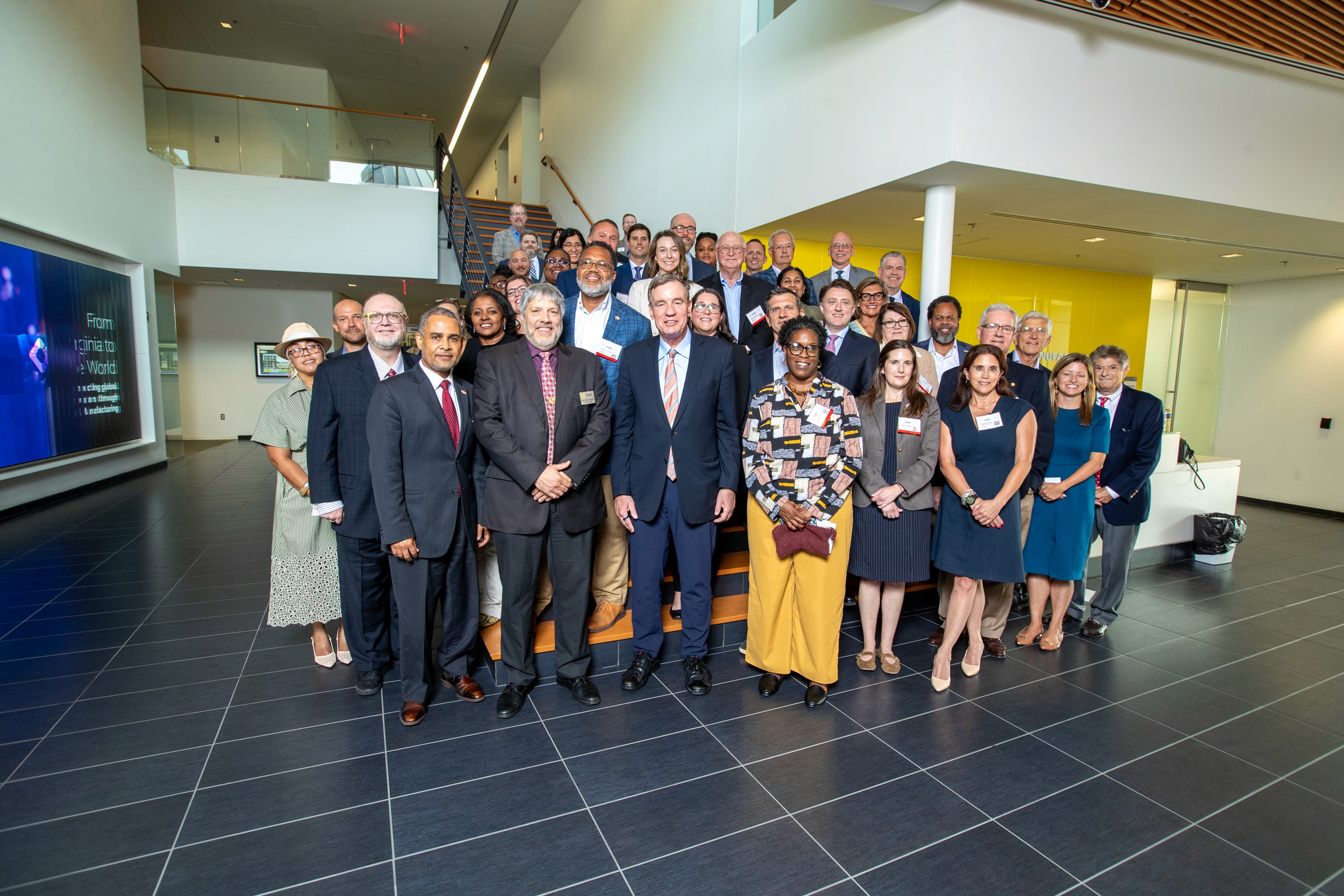
On August 12, Occam co-founder and CEO James Ferri joined an invitation-only roundtable hosted by Senator Mark Warner at the Commonwealth Center for Advanced Manufacturing in Disputanta, Virginia. The occasion was the recent EDA award to the End-to-End Commercialization Project – the fully domestic medicine pathway we wrote about in July. But the milestone was the afternoon’s starting point, not its subject.
What filled the room was a harder, broader conversation. Around the table sat the people who actually move this work – industry, academia, government, and capital, convened by the Alliance for Building Better Medicine – and the discussion kept returning to a single thread: the role AI can play in restoring sovereignty to the supply chains the country depends on.
Bigger than four medicines
The project that brought everyone to Disputanta is about essential medicines – the sterile injectables the coalition is reshoring, and the reason Occam, Phlow, and Civica are in this together. (The full breakdown is in our July announcement.) But the vulnerability the room described doesn’t stop at pharmaceuticals.
The same pattern – long, opaque supply lines; a handful of foreign chokepoints; a shortage that arrives before anyone saw it coming – runs through semiconductors, critical minerals, and the rare-earth inputs that modern industry and defense are built on. Medicine is where the stakes are most immediate. It is not where they end. Sovereignty over critical inputs is national infrastructure, and it isn’t something any single company, or any single state, can engineer alone. It takes government, industry, and capital reading the same map. That is exactly who Senator Warner had at the table.
Where AI comes in
Occam’s vantage point is one link in that map: sourcing. The roundtable pressed on what makes that link scalable, and the answer the conversation kept arriving at was AI. Command of a single molecule is valuable. Command that can be systematized, repeated, and transferred across inputs and industries is something else entirely.
Reading disruption before it lands, qualifying new sources faster than a crisis can open them, pipelining redundancy as a matter of routine – done by hand, that is heroics. Done with AI, it is a system. The distance between those two is the distance the country has to cover, and it is the distance Occam was built to close.
"The focus of the room was restoring sovereignty to the supply chains that provide the medicine American's need. This requires thinking all the way back to the critical inputs where it all starts."
— James K. Ferri, CEO + Founder, Occam Systems
The work ahead
The award is real, and so is the coalition behind it. But if the roundtable made one thing clear, it’s that the ambition doesn’t stop at the loading dock. The question Senator Warner put on the table – how the U.S. rebuilds sovereignty over the inputs it can’t afford to lose – is the one Occam exists to answer. We’re glad it’s being asked at this level.
Thank you to Senator Warner, CCAM, and the Alliance for Building Better Medicine for the seat, and for the conversation.
The milestone is real. The work ahead is bigger.
news & updates


The common thread
Whether you're standing up enterprise oversight, designing a new supply chain from scratch, or sourcing what you need this quarter — you're working with the same intelligence, the same command of the molecule, the same advantage.
Different problems. Same answer.
